
PETS DELIVERY EXPERT
A carrier that fits
your pet and the journey.
Start with your pet’s measurements and the proposed route. The right container needs to work for the animal, the travel format and every operating flight, before you commit to a purchase.
- Published
- Sources checked
Planning guidance for domestic dogs and cats traveling as pets. This is not a complete construction specification or an airline acceptance certificate. Assistance-animal arrangements and other species need separate assessment.
1. Confirm the travel format before buying
Identify whether the proposed journey uses cabin travel, accompanied baggage in the hold or a separate cargo booking. These arrangements can have different container, booking and handover conditions.
Check the airline actually operating each flight, including connections. Ask about the permitted container type, size and weight, your pet’s eligibility and available space. A passenger booking does not by itself confirm a pet booking.
For example, Lufthansa publishes separate conditions for cabin pets and accompanied hold transport. Use the current policy for your own operating carrier.
Sources: IATA: in-cabin operational guidance · Lufthansa: operating-airline checks.
For booking steps and airline-specific checks, explore our airline pet travel guides.
2. Measure the pet and the container separately
With your pet standing naturally, record these measurements and state whether you used centimeters or inches:
- Body length, from the nose to the base of the tail.
- Height from the floor to the elbow.
- Width across the shoulders or the widest part of the body, whichever is greater.
- Height from the floor to the top of the head or ears, whichever is higher.
For an existing container, record both usable internal space and overall external dimensions, plus the pet’s weight and the empty container’s weight. Include the intended bedding when checking usable height.
Measurements are a starting point. Check the actual pet can sit and stand upright, turn while standing and lie naturally inside. A product size label does not establish fit.
3. Check cabin fit in the travel position
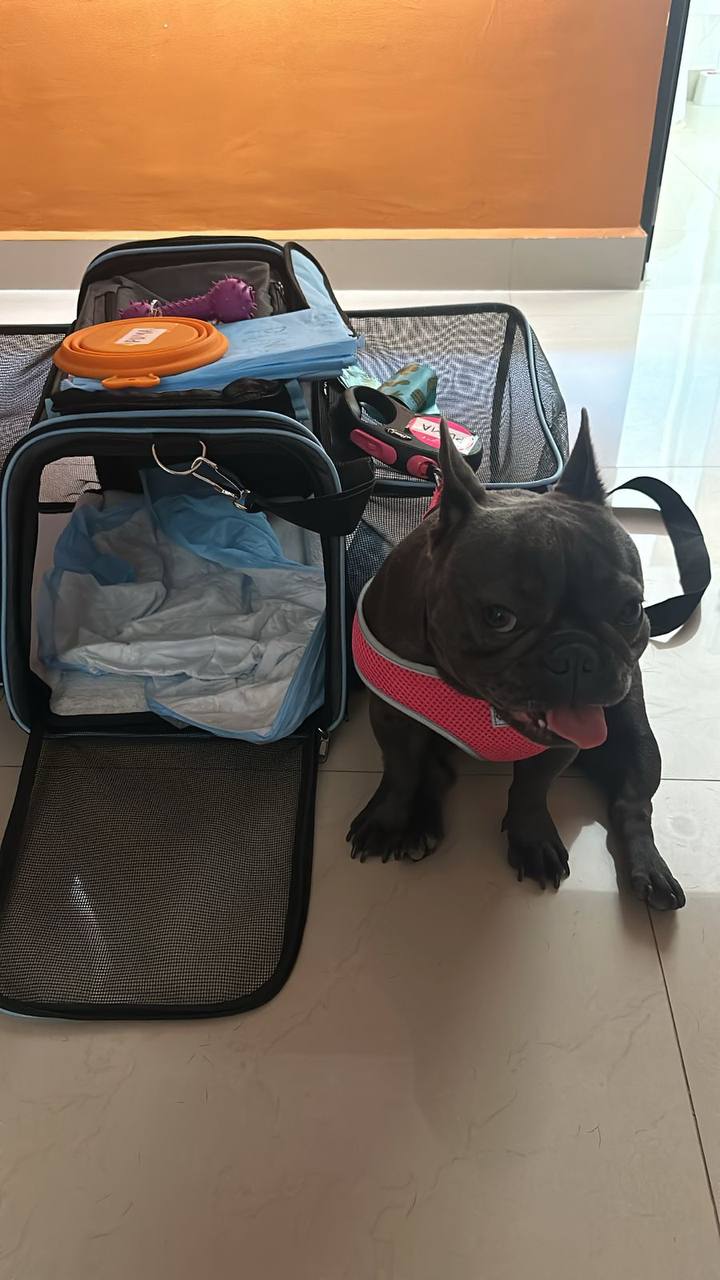
A soft carrier needs to work when closed and placed in the space permitted by the airline. Check your pet’s posture and the ventilation in that position, rather than relying on how roomy the bag looks when fully expanded at home.
Compressing a carrier beneath a seat can reduce airflow. Keep ventilation openings clear and confirm that the chosen design, fastenings and leak-proof base meet the operating airline’s conditions. Fitting beneath a seat is only one part of the assessment.
Sources: IATA: guidance for dogs and cats traveling in the cabin (PDF).
A recommended size is not always the aircraft’s maximum. Delta, for example, publishes a recommended carrier size but says the maximum depends on the aircraft. The carrier must fit completely under the seat, with room for the pet to move without touching or protruding from its sides. Ask for the limit for your aircraft before deciding whether to keep or replace your carrier.
Airline example, checked October 11, 2026: Delta: cabin-carrier requirements. The questions below explain American Airlines’ separate allowance and route limits.
4. Inspect the crate for hold or cargo travel
Use the specification for the confirmed service. Check the rigid container’s condition, secure door and fastenings, smooth interior, leak-proof floor and suitable absorbent lining. Ventilation must remain clear, and handles or spacers must allow safe handling.
Confirm the required food and water fittings, labels and document pouch. The team should be able to provide the agreed care without creating an escape risk. Ask how the container can be accessed safely if an emergency requires it.
Sources: USDA APHIS: preparing and receiving pets for air travel.
Recheck an older crate even if it was accepted on a previous journey. Lufthansa’s hold policy, for example, includes ventilation requirements effective 4 May 2026 and warns that non-compliant containers can be refused at check-in.
5. Allow time to get used to the carrier
Once the container type and fit have been checked, introduce it well before departure. Give your pet time to become familiar with the space and discuss persistent distress or fitness concerns with your veterinarian. There is no single preparation period that suits every animal.
Tell the travel team about a short-nosed breed, health condition or difficulty settling. A larger container alone does not establish that the pet can travel on a particular route.
Sources: FDA: preparing pets for travel · IATA: guidance for dogs and cats traveling in the cabin (PDF).
Bring these details to the route review
Start with the departure and destination cities, approximate dates, whether you will travel with your pet, and each animal’s breed, age and weight. Have the measurements above ready, along with any existing container’s make, model and dimensions. Clear photos of the pet standing naturally and the container’s interior, door and ventilation can help the assessment.
Pets Delivery Expert coordinates container planning with the route, flights, travel-document preparation and agreed handovers. For the entry documents, use the relevant destination guide; U.S. departures also have a dedicated export-planning guide.
Request a route and quote, or explore our cat transport, dog transport and large-dog transport services.
Questions before you book
Is a slightly bigger soft carrier automatically too large?
Not necessarily. American Airlines allows some flexibility for collapsible soft carriers when they fit under the seat without excessive compression and your pet fits comfortably inside the closed bag. This applies only on eligible American routes: ordinary carry-on pets are not accepted on its transatlantic or transpacific trips. Before replacing your carrier, send its make, model and dimensions so we can check the rule for your proposed flights.
Read more: American Airlines: soft-carrier and route rules
Does an “IATA-approved” label guarantee acceptance?
The label alone cannot confirm that a carrier suits your journey. IATA publishes container standards but does not approve individual brands or models. We can help check the carrier against your pet’s measurements and the operating airline’s requirements before you buy.
Read more: IATA: Container Requirement 1, January 2026 (PDF)
Can two pets share a travel container?
Check before buying. Permission depends on the animals, travel format, applicable rules and operating carrier. Pets that live together may still need separate containers; send details and measurements for each animal.
Can I reuse a crate from a previous flight?
Possibly, after a fresh check of its condition, your pet’s current fit and the new itinerary’s requirements. Previous acceptance does not confirm acceptance for another airline, aircraft or journey.
Related reading: International cat transport · International dog transport · Large-dog transport · Pet transport without the owner · Pet shipping cost guide · Destination entry guides.
Sources and carrier references
- IATA: Container Requirement 1, January 2026 (PDF)
- IATA: guidance for dogs and cats traveling in the cabin (PDF)
- IATA: Traveler’s Pet Corner
- USDA APHIS: preparing and receiving pets for air travel
- Lufthansa: animals in the cabin
- Lufthansa: animals as accompanied excess baggage
- FDA: preparing pets for travel
- IATA: Operational Guidelines for In-Cabin Pet Transport (PDF)
- Lufthansa: traveling with animals
- American Airlines: soft-carrier and route rules
- Delta: aircraft-specific cabin-carrier limits
Confirm the actual container, pet and itinerary with each operating carrier before booking. Where government transport rules apply, check those requirements separately.
LET’S ARRANGE THE JOURNEY
Your companion.
Your next chapter.
Tell us where your pet is and where they need to go. We will organize the journey around them.
Start with the route
Share your departure and destination cities, your pet’s breed and weight, your preferred dates, and whether you will travel together. We will assess the route and prepare a transport proposal with the services included.
Request a route & quote