
PETS DELIVERY EXPERT
Flying with a pet
on American Airlines.
Start with the travel format. A passenger ticket does not reserve a pet space, and American’s ticket-counter checked-pet option is limited to specific travelers.
- Published
- Sources checked
An independent Pets Delivery Expert planning guide for ordinary dogs and cats, with a separate section for genuine disability-trained service dogs. This is not airline support, airline endorsement or a booking confirmation. Government and operating-carrier requirements remain separate.
1. Choose cabin, eligible checked baggage or cargo
Small eligible dogs and cats may travel in the cabin. Ticket-counter checked pets are limited to active-duty U.S. military and State Department Foreign Service personnel on official orders. Other larger pets need separate PetEmbark assessment.
Sources: American Airlines: traveling with pets · American PetEmbark: live-animal transport.
2. Measure the pet inside the carrier
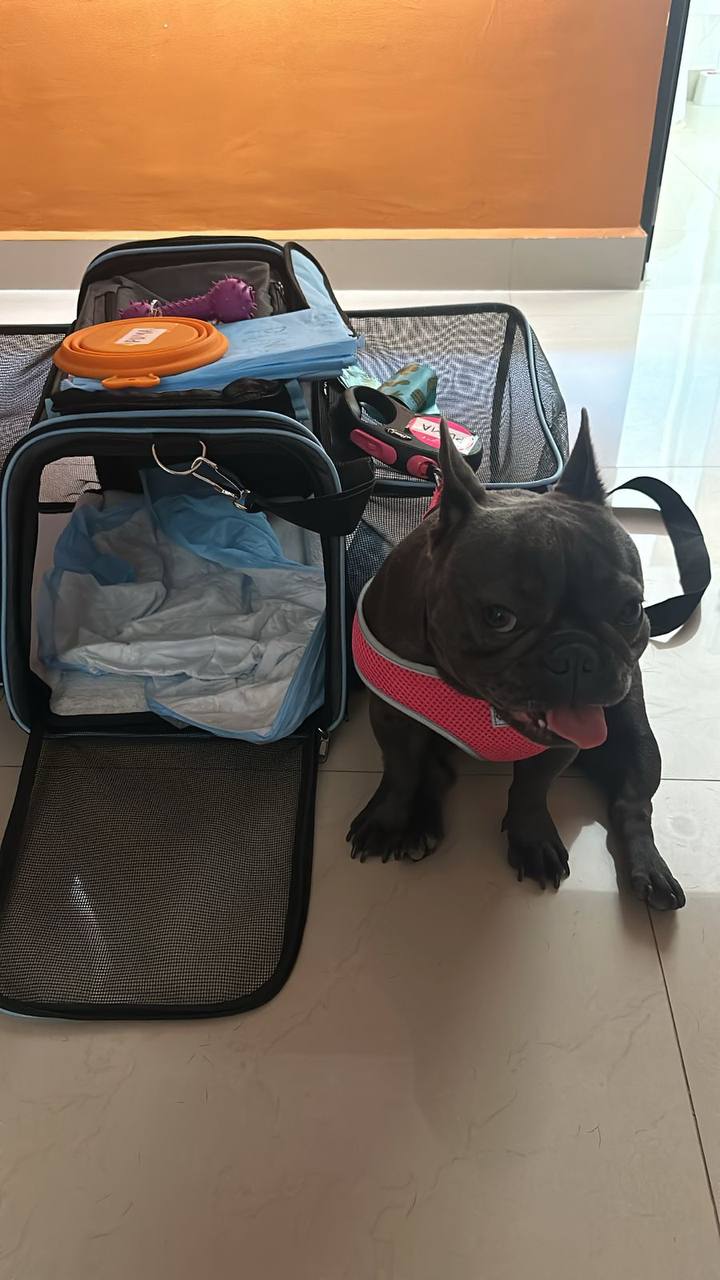
American recommends soft carriers up to 18 × 11 × 11 inches. Published hard-carrier maxima are 19 × 13 × 9 inches on mainline flights and 16 × 12 × 8 inches on American Eagle. Comfortable fit and the actual aircraft’s under-seat space still control. The usual service keeps the pet enclosed beneath the seat. On a three-cabin A321T in First or Business, American directs the carrier to a dedicated compartment. Other cabin and seat restrictions apply.
Measure the closed carrier at its widest points. A product sold as “airline approved” cannot confirm the aircraft or your animal’s fit. Our carrier guide helps you prepare measurements.
Sources: American Airlines: traveling with pets.
3. Check the route before buying
Ordinary cabin pets are excluded on transatlantic and transpacific trips, to or from Hawaii, and on listed country routes. American also restricts cabin dogs with recent high-rabies-risk-country history. Service dogs have separate rules.
Check every operating flight, including the return, against the linked destination and aircraft lists. Keep the pet confirmation with your flight details and ask for a fresh review after a reroute.
Sources: American Airlines: traveling with pets.
4. PetEmbark needs its own booking
American Cargo’s general guide recommends requesting a reservation 24 hours to 10 days before departure. For London Heathrow arrivals, that guide says 30 days while its location-specific rules give a 60-day booking window. Confirm the applicable window with Cargo; document and route planning should start earlier. Dogs must meet its domestic or international age conditions, and the route must have compatible aircraft.
Confirm the exact cargo drop-off and collection facilities; do not assume passenger check-in is the correct place. Take the requested identification and documents, keep the air waybill number, and allow for customs clearance. The general booking guide describes payment after airport acceptance, but shipments to Honolulu must be prepaid under the location-specific rules.
PetEmbark currently excludes new U.S.-bound dog bookings involving a high-rabies-risk country in the preceding six months. A connection in a lower-risk country does not remove that history. Shipments to destinations outside the U.S. require a customs broker and can incur destination charges. Shipments starting outside the U.S. must be arranged with the qualified freight forwarder or professional pet shipper specified by Cargo’s location rules.
Sources: American PetEmbark: planning and booking · American PetEmbark: live-animal transport · American PetEmbark: location-specific rules.
5. A cargo crate must pass a physical inspection
The pet needs room to stand, sit upright, turn normally and lie naturally. Measure body length, leg length, width and standing height before choosing a crate. American’s kennel calculator is guidance, not acceptance; the aircraft table also limits which crate can travel.
Use the complete construction checklist for the door, fasteners, ventilation, floor, dishes and labels. A crate can have adequate internal space and still be unsuitable for a particular aircraft. Do not buy solely by a manufacturer’s “small,” “large” or “IATA” label.
Sources: American PetEmbark: kennel requirements.
6. Breed, weather and sedation can stop cargo travel
PetEmbark excludes its listed short-nosed dogs, cats and mixes, plus specified other dog breeds. Consult the complete list and disclose the breed accurately. Do not assume a passenger-cabin allowance overrides a cargo restriction.
Cargo’s ordinary ground-temperature range is 45–85°F at origin, connections and destination. A qualifying veterinary acclimation letter is required for 20–44°F; below 20°F or above 85°F transport is not accepted. The annual May 1–September 30 embargo also covers Phoenix, Las Vegas, Tucson and Palm Springs. Recheck the forecast close to departure.
Sedated or tranquilized household dogs and cats are not accepted. Discuss medical fitness with your veterinarian without treating medication as a way around an airline rule.
Sources: American PetEmbark: policies and restrictions · American PetEmbark: live-animal transport.
7. Separate the pet fee from the full journey cost
The published cabin fee is US$150 per kennel, each way; a connection of four hours or more triggers another segment charge. Passenger pet fees are nonrefundable. Check the separate Canada-origin schedule.
Cargo pricing follows the shipment service, route, loaded weight and crate. Use the American Cargo rate calculator where applicable, then obtain a shipment quote including handling, any required comfort stop and destination costs. A calculator result does not establish route or breed acceptance.
For a connection, ask whether the timetable requires a comfort stop and what happens if weather delays acceptance. Keep the pet and passenger cancellation conditions together when deciding how much to commit in advance.
Sources: American Airlines: traveling with pets · American Cargo: rate calculator · American PetEmbark: policies and restrictions.
8. Prepare airline and entry documents separately
Use PetEmbark’s document checklist for the shipment rather than a generic online template. Establish which originals, copies, veterinary certificates and shipper declarations are required for the actual departure and destination. Check dates against both the outbound and return journey.
For U.S. entry, CDC requirements apply to returning dogs and service dogs as well as ordinary pets. The route depends on the dog’s six-month travel history and vaccination history. Airline acceptance can be narrower than government eligibility.
U.S.-origin dogs traveling from the U.S. to Mexico: APHIS’s current instructions require a USDA-accredited veterinarian’s NWS inspection certificate issued within five days before entry, effective August 3, 2026. Its stated pathway is for dogs originating in and proceeding from the U.S.; do not apply it automatically to every dog transiting there. Separately, dogs entering the U.S. from screwworm-affected countries need the applicable APHIS certification.
Sources: American PetEmbark: required documents · CDC: bringing a dog into the U.S. · USDA APHIS: pet travel from the U.S. to Mexico · USDA APHIS: bringing a pet dog into the U.S..
Service dogs: a separate disability-related process
American accepts qualifying dogs individually trained to perform disability-related work or tasks, including psychiatric tasks, without a transport fee. Emotional-support animals, comfort animals and dogs still in training use the ordinary-pet process.
American recommends submitting the DOT transport form at least 48 hours before departure and also allows presentation at the airport. Its page requests a relief attestation for flights over eight hours. Keep the forms with you. The dog must be controlled, behave appropriately and fit safely; final acceptance is assessed at the airport. An approved Service Animal ID does not remove those checks.
Confirm partner-flight procedures separately and complete destination approvals well in advance. A purchased certificate or vest does not create service-dog eligibility. Government entry requirements still apply.
On flights covered by U.S. DOT rules, a safety or behavior refusal requires an individual assessment independent of breed. Do not apply the ordinary cargo breed list as a blanket service-dog ban. Ask the airline’s accessibility team to resolve the dog’s accommodation and any destination-specific restrictions.
Sources: American Airlines: service animals · U.S. DOT: service animals · 14 CFR 382.79: individual assessment.
Prepare your route review
Send the departure, destination, travel date, connections and operating flights, together with your pet’s breed, age, weight and measurements. Include the carrier’s external dimensions, loaded weight and any airline response already received.
We can use that information to review the transport format and the preparation still needed. Request a route and quote, or read about dog transport, cat transport and travel without the owner. Airline acceptance remains the airline’s decision.
Questions before you book
Does a cargo rate estimate reserve my pet’s space?
No. Use it for budgeting, then obtain confirmation of the route, aircraft, container and animal acceptance. Keep the resulting booking and air waybill details.
Read more: American Cargo: rate calculator · American PetEmbark: planning and booking
Can I use a crate calculator result as acceptance?
No. American expressly treats its kennel calculator as guidance. The physical inspection and aircraft compatibility still matter.
Read more: American PetEmbark: kennel requirements
Does a service-dog form replace import paperwork?
No. Disability-related cabin documentation and animal-entry requirements are separate checks. Prepare both for the actual route.
Read more: American Airlines: service animals · CDC: bringing a dog into the U.S.
Related reading: Airline pet travel guides · Carrier fit and preparation · U.S. dog-entry planning · Pet shipping cost guide.
Official sources and scope
- American Airlines: traveling with pets
- American Airlines: service animals
- American PetEmbark: live-animal transport
- American PetEmbark: planning and booking
- American PetEmbark: kennel requirements
- American PetEmbark: policies and restrictions
- American PetEmbark: required documents
- American Cargo: rate calculator
- U.S. DOT: service animals
- 14 CFR 382.75: service-dog documentation
- 14 CFR 382.79: individual assessment
- CDC: bringing a dog into the U.S.
- USDA APHIS: pet travel from the U.S. to Mexico
- USDA APHIS: bringing a pet dog into the U.S.
Official sources checked October 11, 2026. Rules and availability can change. Obtain confirmation for the animal, container, operating flights and travel date before making non-refundable arrangements. The service-dog page says “over 8 hours,” while DOT regulations permit relief forms for flights scheduled for 8 hours or more; confirm the form for an exactly eight-hour flight.
LET’S ARRANGE THE JOURNEY
Your companion.
Your next chapter.
Tell us where your pet is and where they need to go. We will organize the journey around them.
Start with the route
Share your departure and destination cities, your pet’s breed and weight, your preferred dates, and whether you will travel together. We will assess the route and prepare a transport proposal with the services included.
Request a route & quote