
PETS DELIVERY EXPERT
Flight changed?
Recheck the whole journey.
A new passenger itinerary is only the start. Recheck your pet’s place, operating airline, carrier fit, documents and arrival arrangements before relying on the replacement.
Official sources open in a new tab.
- Published
- Sources checked
Planning guidance for ordinary pet dogs and cats, especially journeys departing the United States. Assistance and service dogs need a separate assessment. This checklist is not a universal airline rebooking policy or a guarantee of acceptance.
The airline will not accept your pet’s breed: what options remain?
One airline’s refusal does not always mean the journey is impossible. First establish what is restricted: the breed, transport service, particular flight or entry into the country. Then assess other permitted options.
See airline breed restrictions
What caused the refusal?
Ask for the rule applying to the operating airline and your transport service. A breed prohibition differs from exceeding the permitted combined weight of pet and container, unavailable pet space or an aircraft restriction. Cabin, accompanied baggage and separately booked cargo can have different conditions. Destination and transit rules are separate: changing airlines does not remove an import ban.
Another airline, route, cargo service or charter
Another airline or flight. Check the actual breed or known cross, pet and container measurements, every segment and operating carrier. A passenger seat confirmation does not establish a pet reservation.
Another route or date. Aircraft, connections or seasonal conditions may differ. A new itinerary requires reassessment of documents, transit and handovers; more connections do not automatically make it suitable.
Separate cargo shipping. This requires confirmed acceptance of the actual breed by the cargo carrier. Checked-baggage restrictions do not always match cargo rules, but a cargo-service link or larger crate does not establish eligibility.
A suitable charter. A private or shared charter may offer different pet accommodation. Before payment, confirm the operator, space for the individual pet, itinerary and entry conditions. A charter does not remove country requirements.
What specific routes show
- USA → Italy: The guide separates ordinary cabin restrictions from a pet-friendly charter option to assess. A published offer is not a confirmed reservation.
- USA → Australia: The section explains working through an approved pet travel specialist and the sequence of arrangements. Import permission, quarantine preparation and carrier acceptance are separate stages.
- USA → Singapore: SQ’s checked-baggage prohibition does not automatically become cargo acceptance. Confirm the carrier first, then arrange reception and clearance through the appointed agent.
- USA → Japan: After ANA’s seasonal restriction, the actual flight, container and connection still need agreement. The end of the restricted season does not confirm transport.
What to prepare for an assessment
Provide breed and known mix, age and weight, pet measurements, container dimensions and weight, departure and destination cities, preferred dates and flexibility. Say who travels with the pet, which documents are ready and what the airline actually said. A description is enough for the initial enquiry; personal document numbers and scans are not needed.
For a brachycephalic pet, discuss individual fitness for the whole journey with your veterinarian, taking health into account. Airline acceptance and veterinary assessment do not replace each other. Separate rules for service dogs.
We specialise in international transport for brachycephalic pets. We can help work through a complex route and organise the journey around your pet’s needs. Contact Pets Delivery Expert.
This section draws on materials checked on 28–29 October 2026.
Start by identifying exactly what changed
Keep both the original itinerary and the replacement. Compare every segment, including a domestic flight connecting to an international departure.
| Change | What needs checking |
|---|---|
| New flight number or departure date | Pet availability and confirmation for the replacement flight |
| Different operating airline | That airline’s pet policy, booking process and route restrictions |
| Different aircraft | Container limits, usable under-seat space and permitted transport format |
| Different seat or cabin | Whether a pet carrier is allowed in that location |
| New connection or airport | Transfer arrangements, transit requirements and collection responsibilities |
| Changed arrival date or time | Document validity, treatment deadlines and receiving arrangements |
| Owner and pet now traveling separately | Import category, owner-travel timing and authorized handovers |
This is our planning checklist. It is not a universal airline rebooking policy. The checks required depend on what changed.
1. Ask whether the pet is confirmed on each replacement flight
Ask the airline to identify the pet’s booking status for every new segment. If the answer is “requested,” ask whether the request has actually been accepted.
Keep the updated confirmation with your itinerary. An email confirming your passenger seat should not be treated as evidence of the pet’s status unless it explicitly covers the animal.
Delta, for example, requires a separate pet reservation and limits the number of cabin pets on each flight. Its booking instructions ask passengers to provide kennel dimensions.
Ask the airline: “Please confirm that my dog or cat is accepted on each replacement flight, in the agreed travel format, with the carrier dimensions provided.”
If an itinerary has already changed automatically, contact the airline promptly. Do not assume that either the pet reservation or a previously discussed carrier exception has transferred.
Sources: Delta: pet travel.
2. Check the airline operating the aircraft
The airline selling the ticket may be different from the airline operating one or more flights.
Lufthansa explicitly states that its animal-transport rules apply to Lufthansa-operated flights. For codeshares, travelers must check the operating airline’s rules; journeys involving several airlines require confirmation from each relevant carrier.
Read the “operated by” line on the replacement itinerary. Record the operator for every segment.
An airline partnership, shared booking reference or familiar flight-number prefix does not answer whether the replacement operator will carry your pet.
Our flight connections guide explains how to review the transfer between flights.
Sources: Lufthansa: traveling with animals.
3. Recheck your soft carrier against the replacement aircraft
A carrier accepted on the original plan may need another assessment after an aircraft change.
Delta states that maximum cabin-carrier dimensions depend on the aircraft’s under-seat space. Its recommended 18 × 11 × 11-inch soft carrier fits most aircraft types; that recommendation is not confirmation for every aircraft or seat.
Have these details ready:
- Carrier manufacturer and exact model.
- External length, width and height in its closed travel configuration.
- Usable internal dimensions with the intended bedding.
- Your pet’s weight and the total loaded carrier weight.
- Your pet’s standing height, body length and width.
- Replacement aircraft, cabin and seat, if assigned.
For an expandable carrier, record both the closed and expanded dimensions. Assess the pet’s space in the configuration permitted during the flight. Do not count an expanded side compartment unless the operating airline permits its use in that location.
Can a soft carrier simply be compressed?
Compressibility alone does not establish acceptance.
American Airlines publishes limited flexibility for soft-sided carriers, provided they fit beneath the seat without excessive collapse and meet its other conditions. That allowance belongs to American’s policy; it is not permission to exceed another airline’s stated limits. American also prohibits ordinary carry-on pets on transatlantic and transpacific trips, so its domestic carrier allowance cannot establish a workable U.S.–Europe or U.S.–Asia cabin route.
Where an airline publishes a firm limit without an allowance, treat a larger carrier as a published conflict unless the operating carrier provides confirmation applicable to your case.
IATA warns that compression can obstruct ventilation and cause heat buildup. Its cabin guidance also asks whether the animal can stand, sit upright, turn and lie naturally inside the container. A bag fitting under a seat is therefore only part of the check.
See our carrier measurement and fit guide before replacing a bag.
Sources: Delta: pet travel · American Airlines: traveling with pets · IATA: guidance for dogs and cats in the cabin (PDF).
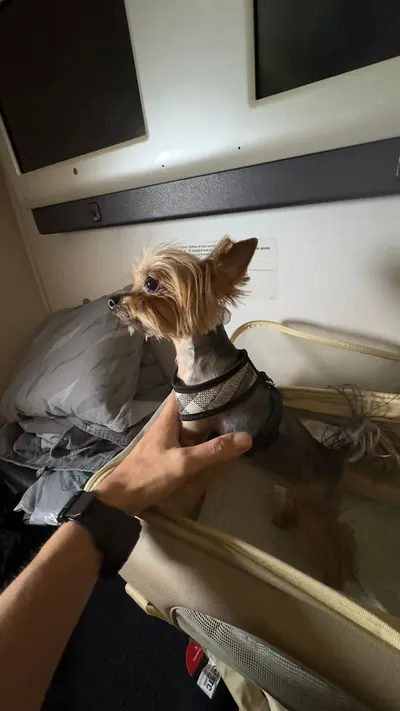
4. Check a new seat or upgrade before relying on it
A more expensive passenger seat can be unsuitable for an ordinary cabin pet.
KLM permits qualifying cabin pets in Economy and in Business Class within Europe, but excludes them from Premium Comfort and intercontinental Business Class because a kennel cannot be placed beneath the seat in those cabins.
Delta also excludes cabin pets from specified seating locations, including bulkheads, exit rows, no-stowage seats and flat-bed or Delta One seats.
After a seat change, ask the airline to check the new seat against the pet reservation. Extra legroom does not necessarily mean usable carrier space.
Sources: KLM: reservation for pets · Delta: pet travel.
5. Recalculate document deadlines using the new journey
Do not assume the original paperwork still covers a changed journey. Review the departure, transit and destination requirements with the veterinarian handling your export documents. IATA’s cabin guidance notes that international travel documents can be time-sensitive and that connecting countries may have additional requirements.
Send the revised itinerary to the veterinarian handling your export paperwork. Ask which dates or details need review:
- Examination, certificate issuance and official endorsement.
- Required treatments and tests.
- Import permits or arrival-inspection bookings.
- First country where the pet will enter and clear customs.
- Owner’s travel date relative to the pet’s arrival.
Do not edit an issued certificate yourself. Ask the issuing veterinarian or authority whether a correction, replacement or other action is required.
Example: a changed arrival time in Great Britain
For a dog traveling directly from the United States to Great Britain, the required tapeworm treatment must fall between 24 and 120 hours before entry. A later arrival can exceed the 120-hour maximum; an earlier replacement can leave less than the required 24 hours after treatment. GOV.UK specifically advises that arrival more than 120 hours after treatment because of a delay may require another treatment and tells travelers to check with their transport company.
Different rules apply when arriving directly from Finland, Ireland, Northern Ireland, Malta or Norway; recheck the actual replacement route. This is a dog-specific requirement, not a treatment instruction for cats. Calculate elapsed hours using the recorded treatment time and revised arrival time, accounting for time zones.
Owner timing also matters: GOV.UK says additional import rules apply when the pet arrives more than five days before or after its owner. A delay affecting only one traveler can therefore require a wider review. These examples concern entry into Great Britain, not Northern Ireland.
Sources: IATA: guidance for dogs and cats in the cabin (PDF) · GOV.UK: tapeworm treatment for dogs · GOV.UK: bringing a pet to Great Britain.
6. Rebuild the connection and arrival handover
Ask who will have custody of the animal throughout the revised journey.
If the pet travels in the hold or as cargo, establish whether it transfers automatically, must be collected, or needs a new handling arrangement. If you travel with a cabin pet, check whether the new connection requires leaving the transit area or changing airports.
Before planning an overnight hotel stay, establish whether both you and the pet can enter the transit country.
Confirm the practical details with the people responsible:
- Where the pet will wait.
- Who provides water and agreed care.
- Who holds the original documents.
- The next check-in or cargo acceptance deadline.
- Whether the receiving agent can attend the new arrival.
- Which additional costs require your approval.
Lufthansa advises checking the departure, transit and destination countries’ import and export rules before booking. A replacement passenger itinerary does not resolve these animal-entry questions.
Sources: Lufthansa: traveling with animals.
If a delay occurs on a U.S. leg of the journey
USDA APHIS training material for airline personnel and handlers of dogs and cats calls for observation during air transport as regularly as possible; the interval of at least once every four hours applies when the cargo area is accessible. Observation also includes loading, unloading and whenever the cargo area is accessible. This is not a promise of access to your pet during flight or continuous observation.
If a pet becomes ill, injured or unresponsive, the material calls for care by a licensed veterinarian: the carrier must determine whether the pet is in physical distress and arrange any necessary veterinary care as soon as possible.
Practical advice: during a delay, ask who is currently responsible for your pet, when its condition was last checked and who will arrange help if its condition deteriorates. This U.S. material does not establish universal handling conditions for every leg of an international journey.
Source for this addition checked October 29, 2026; APHIS material updated January 25, 2026.
Questions owners often need to resolve
My carrier says “airline-approved.” Does that settle the issue?
No. A product label does not identify your operating flight, aircraft or pet. IATA also states that it does not certify or approve particular container manufacturers, brands or models.
The same carrier was accepted before. Can I rely on that?
Previous acceptance is useful background. Record the airline, aircraft, date and pet involved, but check the new journey independently. One successful flight does not establish permission for another.
Can an ordinary pet become a service dog if the replacement flight will not accept it?
A booking problem does not change the animal’s status. Assistance and service-dog arrangements require their own eligibility and documentation review. Use our service-dog guide for that separate process.
Can you guarantee that my carrier will pass check-in?
No. We can compare the supplied measurements and itinerary with published conditions, identify conflicts and coordinate the agreed next steps. The operating airline makes the acceptance decision.
Sources: IATA: guidance for dogs and cats in the cabin (PDF).
Request a review of the complete journey
Pets Delivery Expert organizes managed international pet transport with flight arrangements, document coordination and agreed handovers managed together. Tell us whether you need a complete relocation plan or help with particular stages. Your proposal defines the services included.
Send what you already have:
Hello Pets Delivery Expert. My international flight has changed.
Departure and destination:
Original itinerary:
Replacement itinerary and dates:
Operating airline for each flight:
Aircraft, cabin and seat, if known:
Dog or cat, breed, age and weight:
Pet’s standing height, body length and width:
Carrier make and model:
Closed external carrier dimensions:
Usable internal dimensions:
Total pet and carrier weight:
Original and replacement pet confirmations:
Owner’s travel dates:
Documents already issued and their dates:
Help needed: complete transport / documents and handovers / route review
Include units for all measurements. You can start without passport scans or payment information.
Our initial response is a preliminary comparison with published rules. It identifies which supplied details match, which conflict and which require carrier confirmation. It is not airline or government approval.
Official sources and scope
- Delta: pet travel · checked
- American Airlines: traveling with pets · checked
- KLM: reservation for pets · checked
- Lufthansa: traveling with animals · checked
- GOV.UK: tapeworm treatment for dogs · checked
- GOV.UK: bringing a pet to Great Britain · checked
- IATA: guidance for dogs and cats in the cabin (PDF) · checked
Airline examples apply only to their stated operators and travel formats. Live pet availability, individual exceptions and acceptance for a particular journey have not been verified. Reconfirm the current conditions with the operating airline and relevant authorities for your actual itinerary.
Let’s plan your pet’s journey.
Share your route, dates and pet’s details for a transport proposal.